The role of social sciences in conservation
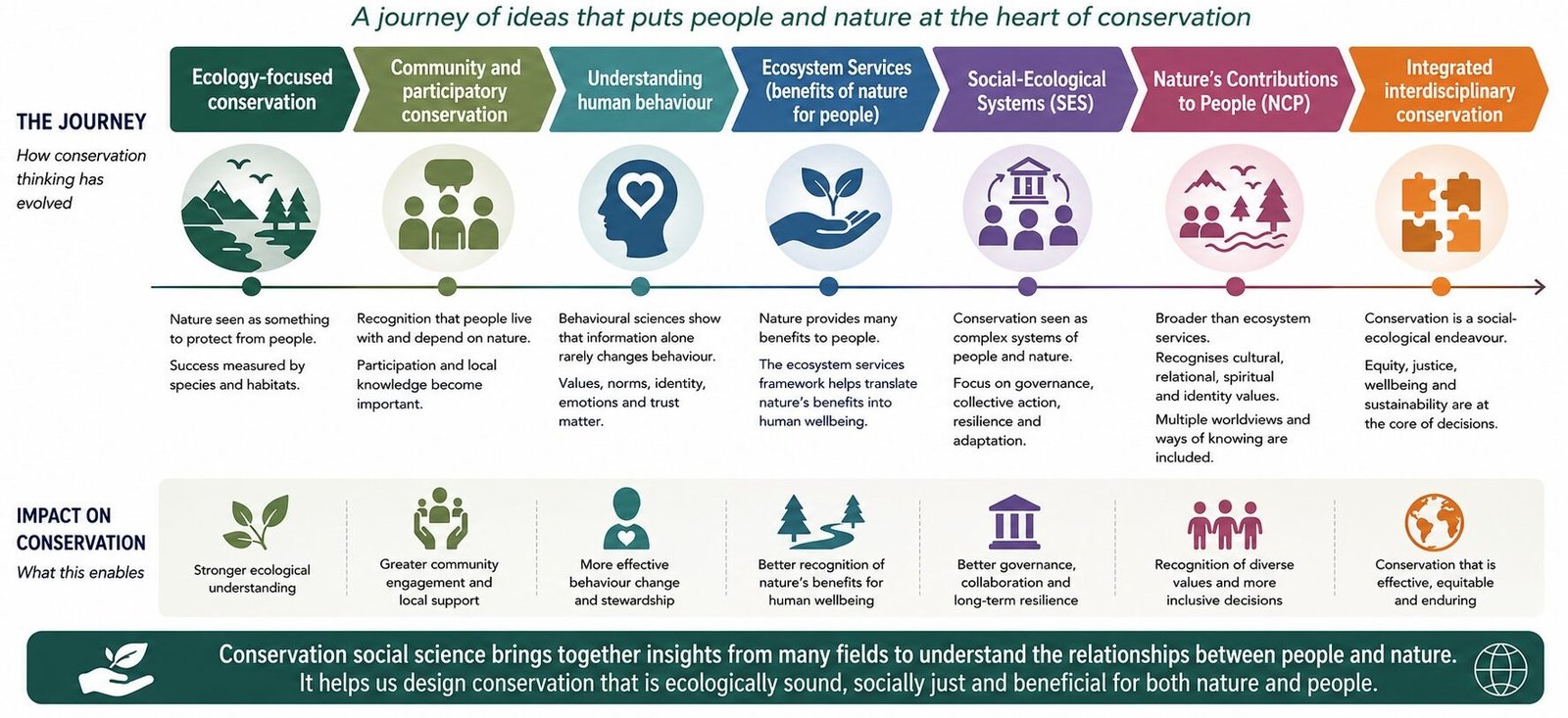
Most conservation problems are, at some level, people problems. A grazing plan is ecologically sound but the farmers who would have to carry it out are not convinced. A new protected area is well designed on paper but arrives without the trust of the people who live there. A restoration project succeeds biologically and still ends up resented locally. In each of these cases the ecology isn’t really the obstacle; the people are.
This is why social science has become part of serious conservation practice, not as an add-on, but because so many of the difficulties conservation runs into are, at root, social ones. Understanding people isn’t separate from the work; often it is the work. A few familiar problems show why.
Why good information doesn’t change behaviour
A common assumption is that if people understood the science, they would act on it. Explain why a habitat matters, and support will follow.
In practice, it rarely works that way. Decades of research show that information alone seldom changes what people do. What shapes behaviour is a wider set of things: values, emotions, habits, identity, trust in the organisations involved, the behaviour of neighbours and peers, and whether people feel they are being treated fairly. Someone may fully accept that a wetland is important and still oppose the restrictions attached to protecting it, because those restrictions touch their livelihood, or because they feel decisions were made without them.
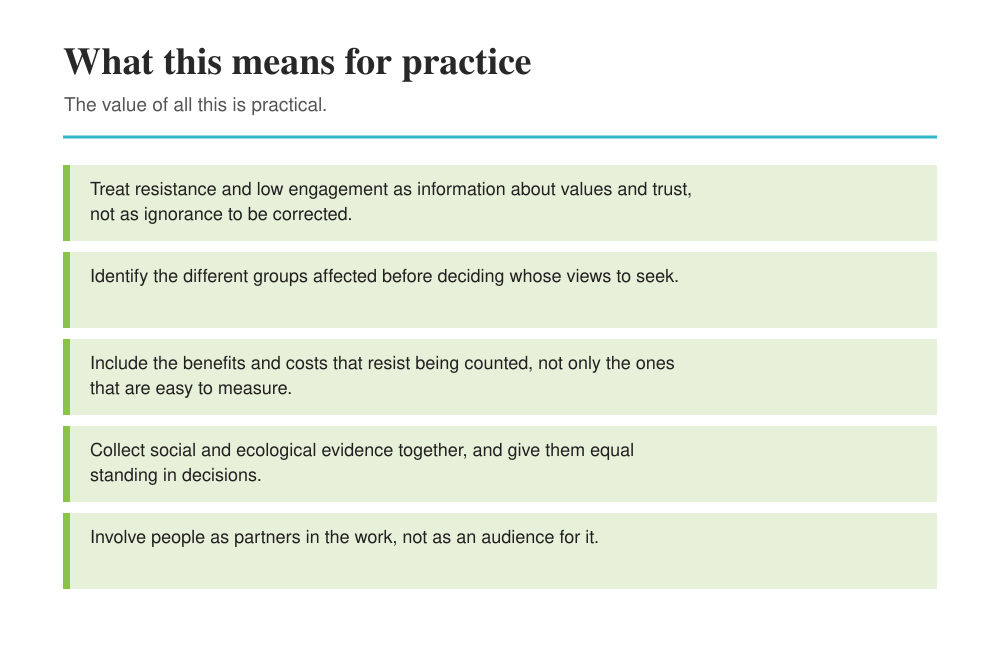
For a practitioner, this changes the task. The question is no longer only “how do we explain this better?” but “what do people here actually value, trust and fear, and how does that shape how they will respond?” Those are social science questions, and they can be investigated rather than guessed at.
Why there is no single community view?
It is natural to ask whether “the local community” supports a project. But as the Sighisoara case study showed, a community is not one voice. A farmer, a tour operator, a second-home owner and a young person hoping to stay in the area may all experience the same protected area very differently.
This matters because it is easy to hear only the most engaged or the most supportive voices and mistake them for everyone. Social science methods exist partly to correct for that: to map out who the different groups are, to reach beyond the usual few, and to make the range of experiences visible rather than averaging them into a single misleading answer.
Why the benefits and costs are hard to see
Conservation produces benefits and costs that don’t show up in economic figures. Some of what people value most about a place (a sense of belonging, cultural heritage, the feeling of connection) is real but difficult to put a price on. These cultural and relational values are easy to leave out of an assessment precisely because they resist being counted, and leaving them out gives a distorted picture of what a project has actually done.
The same is true of costs. Restrictions, lost access, or the sense of being excluded from decisions are genuine effects even when they never appear in a budget. Social science offers ways to surface these harder-to-measure outcomes so that they can be weighed alongside the ecological and economic ones.
What social science actually helps you do
The value of all this is practical. Social science approaches give conservation organisations concrete ways to understand the people side of their work, using methods that are well established and can be scaled to the size of a project:
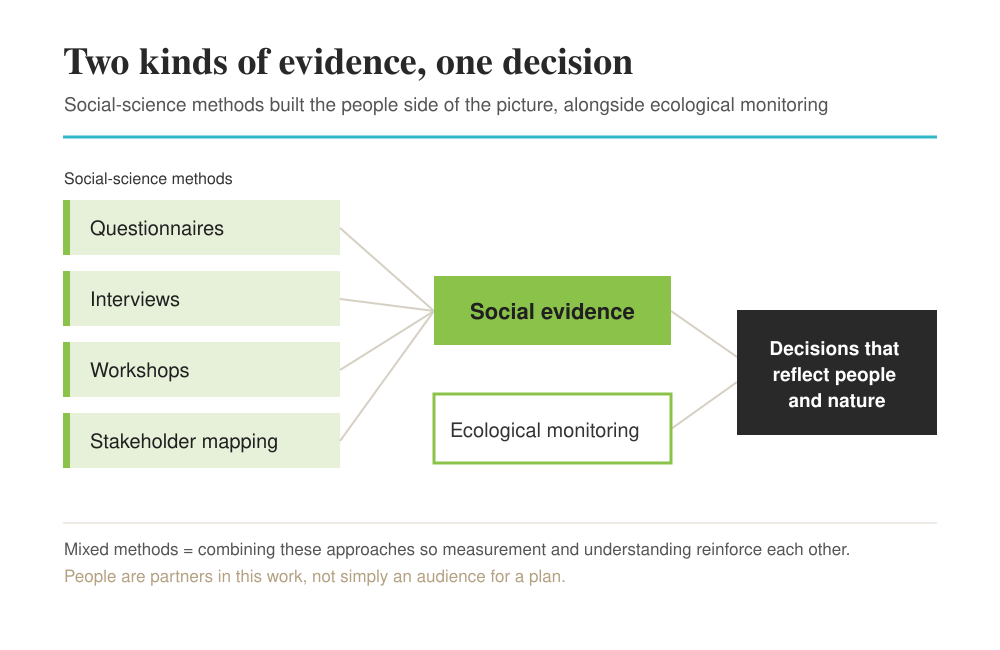
None of these require a research department to be useful. What they share is a commitment to finding out rather than assuming, and to treating people as partners, beneficiaries and stewards of a place rather than as passive recipients of a plan.
The other shift social science brings is integration. A protected area is not an ecosystem with people nearby; it is a system in which the ecological and the social are bound together, each shaping the other. Elinor Ostrom’s work on how communities manage shared resources made this case decades ago, and it holds today: manage the ecology while ignoring the social dynamics and the ecological gains themselves become fragile. In practice this means measuring social and ecological outcomes together, with indicators for both, so that decisions rest on the full picture rather than half of it.
Bringing it together
The same thread runs through this series. The first article set out the wide range of social outcomes conservation can produce, both positive and negative. The second showed what it looks like to investigate those outcomes in a real place. This one explains why the tools for doing so come from social science, and why they belong in everyday conservation practice rather than in a separate academic conversation.
The practical challenge that remains is doing this consistently: using sound methods, measuring the outcomes that matter, and building the results into the monitoring and evaluation that protected areas already carry out. That is what the SOCIAT approach (designed by researchers at the University of Warwick) is set to support: a structured, evidence-based way to assess the social impacts of conservation, so that understanding people becomes a routine part of the work rather than an afterthought.
In our next article Dr Johanna Breyne, Director of Entre-Sambre-et-Meuse National Park, Belgium, will discuss why the park decided to do a social assessment and what they learned from it (Article to be released 19th October).