In a conservation policy or project, some outcomes are easy to point to: hectares restored, species recovering, water quality improving.
These are usually what the project was designed to deliver, and they are the outcomes we know well how to measure.
But sooner or later, someone asks a different kind of question. A funder, a board member, or someone at a community meeting wants to know what the project will do or has done for the people who live there, and often there isn’t a clear answer.
Things did change for those people; it’s just that the effects were never treated as outcomes worth following.
Those outcomes are worth following, because nature policies and projects change ecosystems but also change how people experience, value and use the places around them. They can open up recreation and learning, strengthen local identity, support livelihoods and build trust between communities and the organisations that manage a site, and they can also restrict access, concentrate benefits or strain relationships. These are some of the wider outcomes of conservation.
They have received far less attention than ecological outcomes, but they are increasingly recognised as an important part of successful conservation. They shape public support, encourage long-term stewardship, and help create initiatives that last once the funding cycle has ended.
Seven kinds of social outcomes to look for
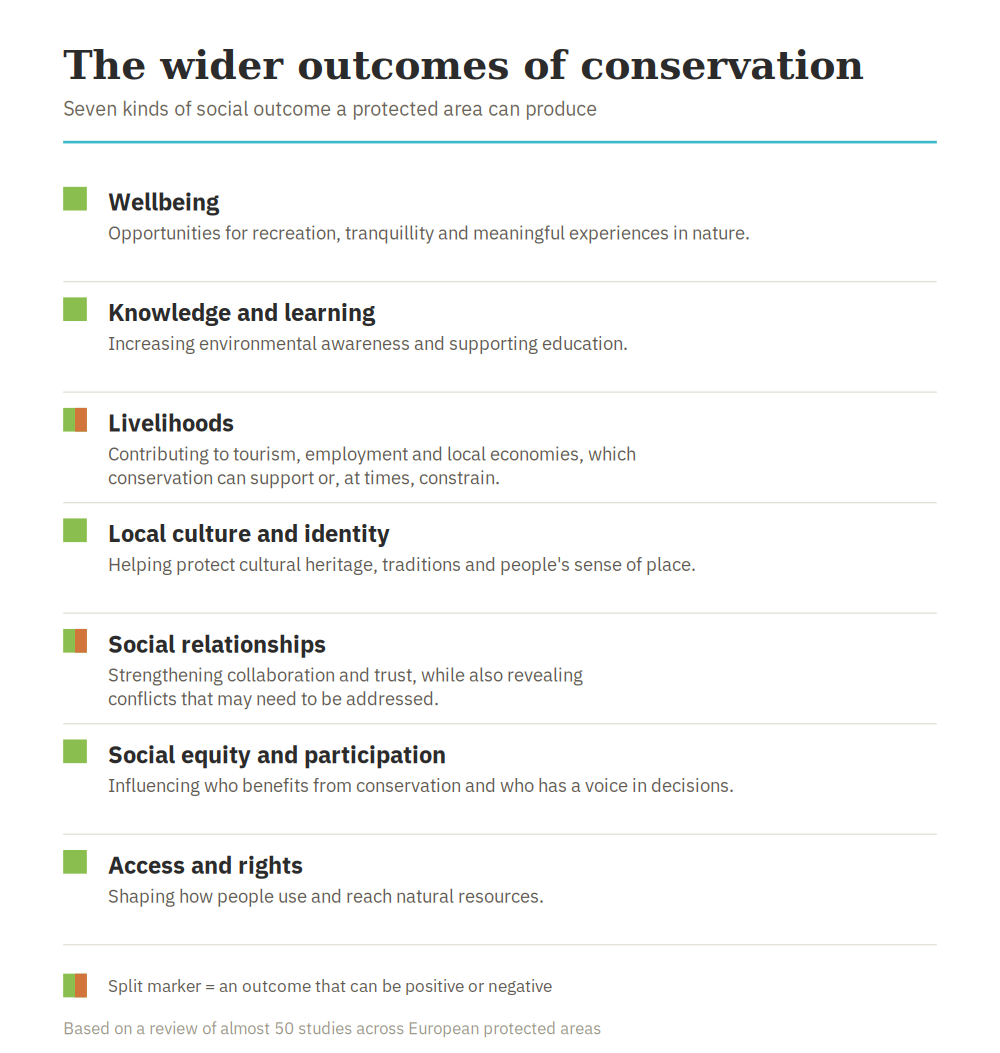
A review we carried out a few years ago looked at almost 50 studies from protected areas across Europe, the most widely applied policy for nature protection, and identified seven broad categories of social outcomes. These categories make a useful starting point: if you want to understand a project’s social side, these are the areas to look at. Two of these deserve a closer look, because they can go either way: livelihoods can be created or lost, and relationships can be strengthened or strained. That isn’t a weakness in the framework — it reflects how conservation actually works on the ground, where social outcomes are never simply a list of benefits to add up.
Not everyone experiences conservation in the same way
What the review showed most clearly is that these outcomes are rarely shared out equally.
Many studies reported clear benefits for wellbeing, recreation, learning and local livelihoods. Others, sometimes describing very similar kinds of project, raised concerns about benefits going to only a few people, restrictions on access to resources that communities relied on, limited involvement in decision-making, or tensions between different groups.
So conservation doesn’t simply generate benefits or costs. What it produces depends on how a project is designed, run and governed, and on whose views are actually taken into account.
And there is rarely a single “community view.” Listen only to a project’s supporters and you will mostly hear that everything is working; listen only to its critics — often the loudest voices in the room — and you may conclude that nothing does. Both readings are partial, and acting on either one alone is how worthwhile projects get stopped, or how real costs get missed.
Why does this matter?
Understanding these wider outcomes helps us move past a single question — how can a project or policy meet its ecological targets? — and ask a broader set alongside it.
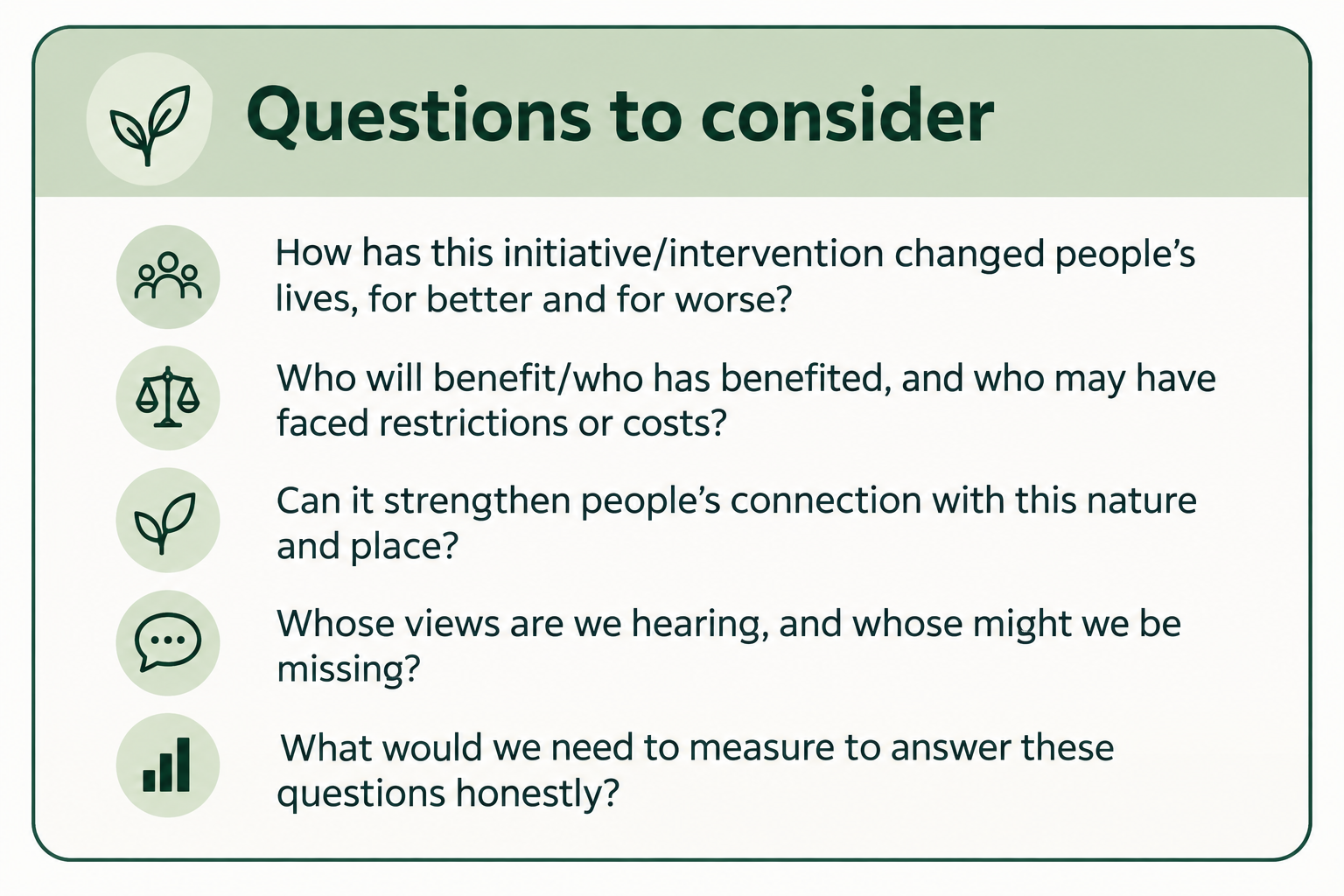
This doesn’t mean putting ecological monitoring aside. It means looking into social outcomes on purpose, instead of assuming we already know them or predict them.
Key takeaway
Successful conservation changes more than ecosystems. It also shapes people’s experiences, relationships and opportunities, and those changes are often uneven. Understanding them can help create conservation initiatives that are more inclusive, better supported and more effective in the long term.
Looking ahead
The next article in the Knowledge Hub follows this into a real place: a NATURA 2000 area in Romania where researchers set out to ask local communities directly what conservation had meant for them, and learned things that ecological monitoring alone could not have told them. A later article looks at the social-science methods that make this kind of work possible, and how they can be built into existing monitoring and evaluation frameworks.
Assessing these wider outcomes systematically is exactly what the SOCIAT approach is designed to support. In January 2027, we will launch our next SOCIAT Training Programme, providing practical training for those who want to apply these approaches in their own conservation work.
Applications will open later this September and close in November 2026. Further details will be announced soon