Protected areas change more than landscapes and seascapes, because they can also change how people use a place, what opportunities they see in it, and how they feel about conservation and restoration. So how do you know what people living around a protected area actually think about it? It’s true that ecological monitoring can tell us whether habitats are improving or species are recovering, but it cannot tell us whether local people feel involved, what worries them, or what opportunities they think a new conservation project might bring.
This is where social assessment can help: in simple terms, it means asking people about their experiences and views, and then using that information alongside ecological evidence to build a fuller picture of what a conservation project is actually doing. We spoke to Dr Johanna Breyne, Director of Entre-Sambre-et-Meuse National Park in Wallonia, Belgium, about why the Park decided to do this and what it has learned from the process.
Officially established in 2023, the Park is still relatively new, stretching across five municipalities and working with a large group of public, private and associative partners, including nature organisations, the public administration, tourism agencies and other local partners. Because much of its work depends on cooperation and voluntary agreements with the people and organisations managing or owning the land, understanding what local communities think about the Park, and how those views change, is particularly important.
Why measure social impact?
Like most conservation organisations, the Park follows up on a set of indicators linked to its activities, as for example the number of events, training sessions, the surface of nature restored, and other projects; what those numbers cannot necessarily tell the team, however, is whether those activities are changing how people understand the Park, how they feel about it, or how they experience its work.
A guided walk may have attracted 50 people, for example, which tells you something about participation, but not whether those people understand the Park better afterwards, whether they trust it more, or whether their concerns have changed as a result of taking part.
This was one reason social questions were included in the Park’s monitoring from an early stage. As Johanna explains, simply knowing how many activities have taken place “doesn’t give really an impact result”, because recording outputs tells the Park what it has delivered without necessarily showing what those activities have changed. To understand impact, the team also needed to look at people’s experiences, expectations and perceptions. That meant asking a different set of questions: what do people think about the National Park, what benefits do they see, what worries them, and how do they perceive possible effects associated with tourism, employment, rewilding or access to forests? The aim, in other words, was not simply to measure what the Park was doing, but to understand how people were experiencing it.
The social assessment forms part of a wider programme looking at ecological, economic and social change, and for the social side of that work the Park brought in external partners and used both a questionnaire and interviews. While the questionnaire helped provide a broader picture of what people thought, the interviews made it possible to explore some of those views in greater depth and better understand what lay behind them. This first assessment was carried out in 2025; although the Park had originally hoped to have comparable information from 2022, Johanna explains that 2025 provides the first set of figures from which changes can now be followed over time.
The Park also plans to repeat the work rather than treating the assessment as a one-off exercise. As Johanna explains, “every four or five years, we will redo the same survey to be able to follow our impact over the different years”, which means the Park will be able to see whether people’s views are changing instead of relying on a single snapshot. For a young National Park, this is particularly useful, because people’s first reactions when a protected area is created may be very different from their views several years later, once they have seen what it actually does, taken part in its activities or experienced changes locally. Returning to the same questions can therefore help the Park understand how its relationship with surrounding communities develops over time, while also using those findings to guide future activities, including how citizens and young people are involved in the Park’s projects as it develops its second operational plan.
What did the Park learn, and what happens next?
One of the more interesting things about the assessment is that it did not reveal an entirely different picture from what the Park was already hearing. As Johanna says, “there were no surprises actually. What we thought that people think, that’s actually what they think”, which might initially sound as though the assessment simply confirmed what staff already knew, but that confirmation is itself useful. The Park already had regular contact with local communities through its staff, public meetings, guided activities and municipalities, so it had a reasonable sense of the issues people were discussing. Some residents were worried about over-tourism and rubbish, while others had concerns about access to woodland or possible restrictions on existing activities; Johanna also remembers misconceptions circulating during the Park’s early stages, including fears that forests might eventually be closed to the public or that visitors would have to pay to enter.
What the assessment adds is a way of moving beyond simply hearing those concerns and asking how widely they are actually shared. If ten people complain very loudly about the same issue, for example, a municipality may understandably start to feel that this represents the wider community, whereas a broader survey can show whether that concern is shared by most people, by a smaller group, or somewhere in between. This does not make the people expressing that concern any less important, but it gives managers a clearer picture of what they are dealing with and helps distinguish between how visible an issue is and how widespread it actually is. That clearer picture can then feed directly into what the Park does. It has recently created a citizen forum where people can discuss issues affecting the area, and findings from the assessment can help identify which topics deserve more attention and which questions might benefit from a more detailed conversation with local residents.
The results can also support discussions with municipalities, because instead of relying only on the concerns of the people who speak up most often, the Park can bring a broader picture of local views into those conversations. This can be particularly useful where an issue is contentious, as evidence about how widely different views are shared gives everyone a more concrete starting point for discussion. The same information can improve communication as well: if many people misunderstand something about the Park, that may suggest that information needs to be clearer; if a concern is genuinely widespread, the team can take it into account when planning a project; and if something is already well understood and supported, attention and resources may be better directed elsewhere.
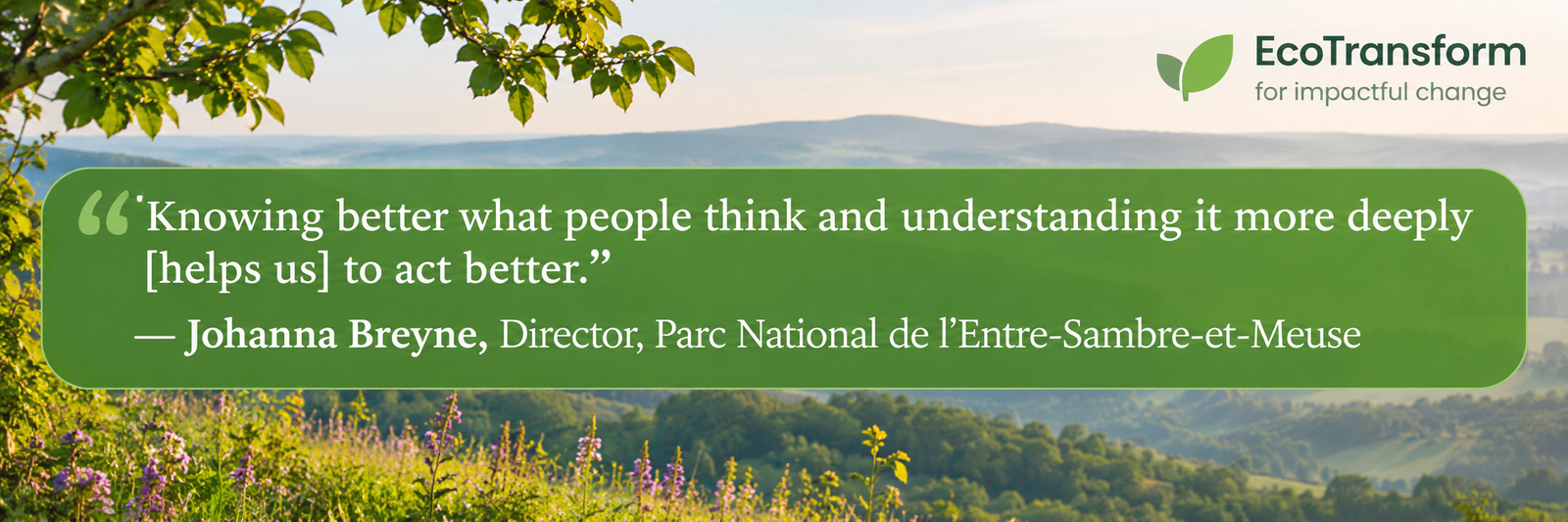
For Johanna, this is ultimately about making better decisions. As she explains, “we’re really convinced from the beginning that actually knowing better what people think and understanding it more deeply [helps us] to act better. Just also when you talk to people, to understand them better. It gives you insights”. What matters in this statement is the connection between understanding and acting, because the assessment is not useful simply because the Park ends up with more information; it becomes useful when that information helps the team decide what needs to be explained more clearly, which issues deserve further attention, and where a future project may require a different approach. Knowing that a concern exists is one thing, but knowing how widely it is shared and having a better understanding of what lies behind it gives managers a much stronger basis for deciding how to respond.
What can other protected areas learn?
An important part of the experience at Entre-Sambre-et-Meuse is that the formal assessment does not replace the Park’s everyday contact with local communities. Many members of staff live in the area themselves, which means they hear questions and concerns through their own networks as well as at events, through municipalities and in ordinary conversations about the Park. That kind of contact remains essential, but it also has limits, because the people who speak most often are not necessarily representative of everyone else, while informal conversations make it difficult to know how common a particular view really is. A social assessment adds another layer by allowing surveys to show how views are distributed across a wider group, while interviews can help explain why people hold those views in the first place.
The two approaches therefore work together rather than competing with one another: everyday conversations keep the Park connected to what people are experiencing locally, while the assessment provides a way of stepping back from individual encounters and seeing whether the same patterns appear across a wider community. This is particularly important because Park staff are often themselves part of the local communities in which they work, and may already have a strong sense of the questions, concerns and expectations circulating around them through meetings, events, staff networks and day-to-day conversations. The value of social assessment lies in adding another layer to that knowledge, helping the Park test those impressions more systematically: is a concern really widespread, why do people feel that way, are those views changing, and is there something the organisation needs to explain or approach differently?
Nor does this mean that every protected area needs its own team of social scientists. Entre-Sambre-et-Meuse brought in external expertise to support the work, showing that what matters is not having every skill in-house, but knowing what you need to understand and finding an appropriate way to investigate it. Not every assessment will produce an unexpected finding, and that does not make it unsuccessful: sometimes confirming what managers already suspected is useful, sometimes a concern turns out to be less widespread than its visibility suggested, and sometimes the most valuable finding is not what people think but why they think it.
For protected areas whose work depends on maintaining good relationships with the people around them, that difference matters, because it can move an organisation from simply hearing that a concern exists to having a clearer idea of what that concern means and what, if anything, it should do next.
Find out more about Parc National de l’Entre-Sambre-et-Meuse on its official website:
https://www.parc-national-esem.be/en
Coming next: Why trust matters in conservation
Understanding how communities perceive protected areas is only part of the picture. Another important question is whether people trust the organisations responsible for managing them. In our next article, “Trust in conservation: what shapes public support for protected areas”, we will explore what research across European protected areas tells us about institutional trust, how it influences public support, and why fair and meaningful participation matters. We also look at how trust can change over time and what conservation organisations can do to better understand and strengthen relationships with local communities.
Coming soon!