The role of social sciences in interdisciplinary conservation

The role of social science in interdisciplinary conservation

Conservation has traditionally been viewed as a biological challenge—protecting species, restoring habitats, and managing ecosystems.

While ecological science remains at the heart of conservation, experience from around the world has demonstrated that conservation is equally a social challenge. Protected areas, restoration projects, species recovery programmes and landscape-scale initiatives all depend on people: the decisions they make, the values they hold, the institutions they create, and the relationships they develop with nature.


A restoration project may fail despite excellent ecological planning if local communities oppose it. Visitor management measures in a national park may have little effect if they do not consider why people behave as they do. Equally, conservation initiatives can generate benefits that extend far beyond biodiversity, strengthening local economies, improving wellbeing, increasing community cohesion and fostering stronger connections between people and nature.


Understanding these human dimensions is the role of social science and humanities.


Conservation social science is an interdisciplinary field that applies knowledge from disciplines including sociology, psychology, anthropology, economics, political science and geography to understand the relationships between people and the natural environment. It examines how social values, governance, culture, institutions, behaviour and economic systems influence conservation outcomes, while also exploring how conservation affects people and society.


Today, conservation social science is recognised as an essential component of effective conservation planning and management. Increasingly, conservation is no longer seen simply as protecting biodiversity, but as managing complex social-ecological systems in which people and nature are fundamentally interconnected.


From protecting nature to understanding people


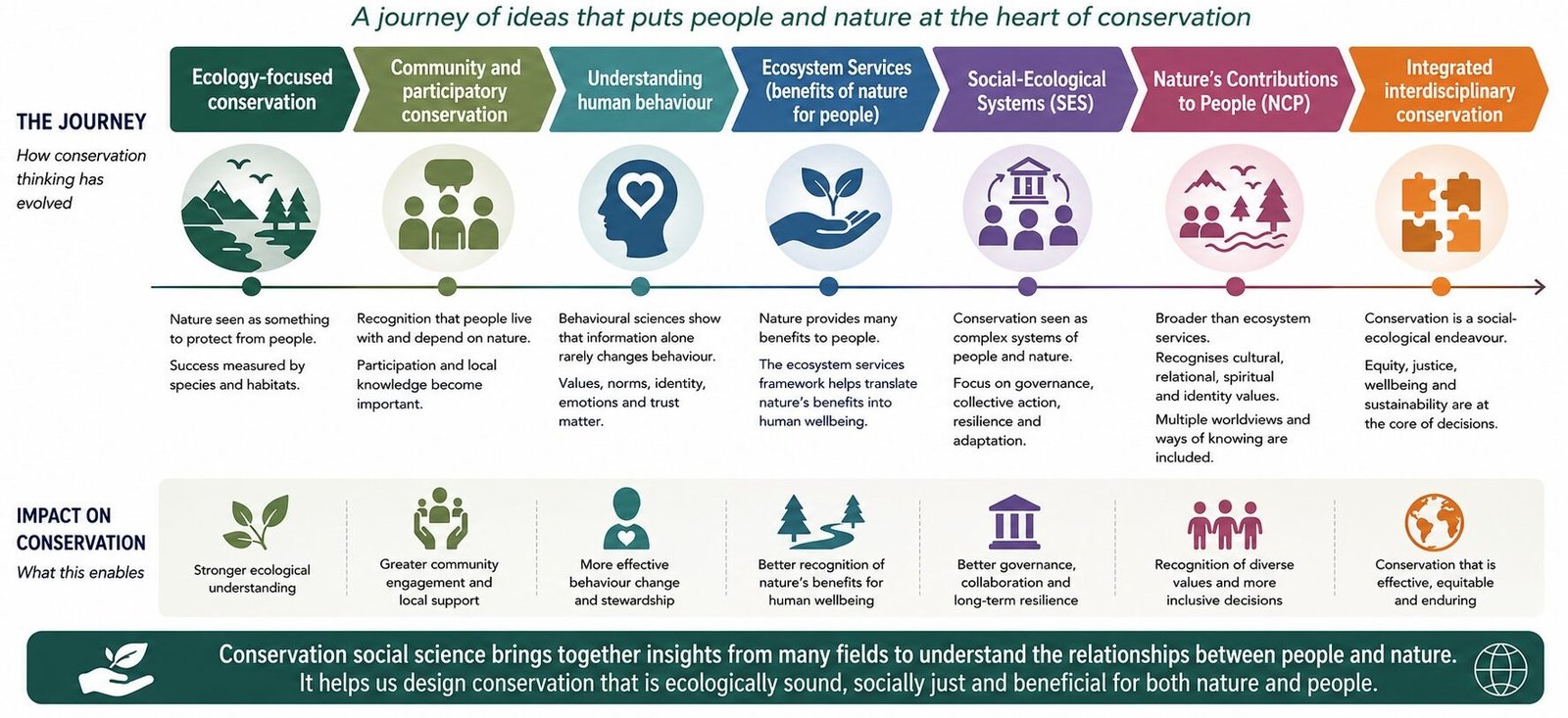
For much of the twentieth century, conservation focused primarily on ecological objectives. Success was measured through indicators such as species abundance, habitat condition and ecosystem health.


Human activities were often viewed primarily as pressures that needed to be reduced or controlled.


While this approach achieved important successes, practitioners gradually recognised that conservation outcomes depended heavily on social factors. Protected areas required public support. Farmers needed incentives to adopt sustainable land management. Visitors’ behaviour influenced sensitive habitats. Communities living alongside protected areas needed to perceive conservation as fair and beneficial.


Projects with similar ecological objectives often achieved very different results depending on governance arrangements, stakeholder relationships and levels of trust.


These experiences led to an important shift in conservation thinking. Rather than treating people as external influences on nature, conservation increasingly recognised that ecological and social systems are deeply interconnected. Understanding biodiversity therefore requires understanding people.


This shift has transformed conservation practice over the past three decades. Participation, stakeholder engagement, governance, environmental justice and social impact assessment have become integral components of conservation planning across protected areas, restoration initiatives and nature recovery programmes.


Why changing behaviour is more complex than providing information


One of the earliest contributions of social and behavioural science to conservation was challenging the assumption that providing information alone would change behaviour.


For many years, conservation campaigns were based on relatively simple models: if people were informed and understood an environmental problem, they would develop positive attitudes and subsequently change their behaviour. Educational campaigns therefore focused heavily on increasing awareness.


However, research consistently demonstrated that knowledge alone rarely produces lasting behavioural change.

Visitors may understand that leaving marked trails damages fragile vegetation but still choose shortcuts. Landowners may recognise the importance of habitat restoration yet hesitate to participate. Residents may support biodiversity conservation in principle while opposing local conservation measures that affect their daily lives.


These apparent contradictions revealed that behaviour is influenced by a much wider range of factors than knowledge alone.

Psychological research showed that values, emotions, habits, personal experiences, identity, trust, social norms and perceptions of fairness all influence decision-making. People’s relationship with nature is shaped not only by what they know but also by what they value and how they perceive conservation.


One influential framework that emerged from this work is the Value-Belief-Norm (VBN) Theory, developed by Paul Stern and colleagues. Rather than viewing behaviour as a direct consequence of information, the VBN framework proposes that environmental behaviour develops through a chain of influences beginning with people’s underlying values, shaping their environmental beliefs, activating personal moral norms and ultimately influencing behaviour.


The importance of this work lies less in any single theory than in the broader recognition that conservation behaviour is multidimensional. Effective interventions therefore combine education with approaches that strengthen trust, encourage participation, build social norms, recognise local values and foster meaningful connections with nature.


Beyond individuals: conservation as a social-ecological system


While behavioural theories improved understanding of individual decision-making, researchers increasingly recognised that conservation cannot be explained solely through individual behaviour.


Protected areas operate within complex systems involving governments, communities, businesses, visitors, landowners and environmental organisations. Decisions made by one group influence many others, creating feedback loops that shape both ecological and social outcomes.


This systems perspective gave rise to the concept of Social-Ecological Systems (SES), strongly influenced by the work of Nobel Prize-winning economist Elinor Ostrom and resilience researchers.


The SES framework views conservation as the interaction between ecological processes and human institutions. Biodiversity outcomes depend not only on ecological conditions but also on governance arrangements, property rights, cooperation, monitoring, trust and collective action.


For example, successful management of fisheries, forests or protected landscapes requires effective ecological monitoring alongside institutions that encourage collaboration, build legitimacy and enable communities to participate in decision-making.


Rather than seeking simple solutions, the SES approach recognises that conservation involves complex adaptive systems where environmental change, social values, governance and economic pressures continually interact.


This systems perspective has become one of the foundations of modern conservation science.


Understanding the benefits people receive from nature


Another major development has been the growing recognition that nature provides numerous benefits that support human societies.


The concept of ecosystem services, popularised through the Millennium Ecosystem Assessment in 2005, highlighted the many ways ecosystems contribute to human wellbeing. These include provisioning services such as food and freshwater, regulating services including flood protection and climate regulation, cultural services such as recreation and tourism, and supporting services that sustain ecological processes.


The ecosystem services framework fundamentally changed conservation by helping demonstrate that protecting biodiversity also protects the systems upon which human societies depend.


However, researchers also recognised important limitations.


Many of nature’s benefits cannot easily be measured economically. Cultural identity, spiritual connections, sense of place, heritage and emotional relationships with landscapes often play central roles in people’s lives but are difficult to express using traditional ecosystem service approaches.


To address these limitations, the Intergovernmental Science-Policy Platform on Biodiversity and Ecosystem Services (IPBES) introduced the concept of Nature’s Contributions to People (NCP).


NCP broadens the understanding of nature’s benefits by recognising multiple ways people value the natural world, including cultural, relational and Indigenous perspectives. Rather than focusing primarily on economic benefits, it acknowledges that people relate to nature through identity, stewardship, belonging and shared cultural practices.


This broader perspective reflects the increasing recognition that successful conservation requires understanding the diverse ways in which different communities experience and value nature.


Measuring the social outcomes of conservation


As conservation increasingly recognised the importance of people, a new question emerged:

How can we measure these social outcomes?


For decades, ecological monitoring has provided detailed information on species populations, habitat quality and ecosystem condition.


Comparable approaches for measuring social outcomes have developed more slowly.


Yet conservation projects influence many aspects of people’s lives. They can improve opportunities for recreation, strengthen connections with nature, increase local pride, support physical and mental wellbeing, create employment opportunities and encourage community participation. At the same time, they may also generate conflicts, inequalities or unintended negative impacts if social considerations are overlooked.


Understanding these outcomes requires systematic social impact assessment.

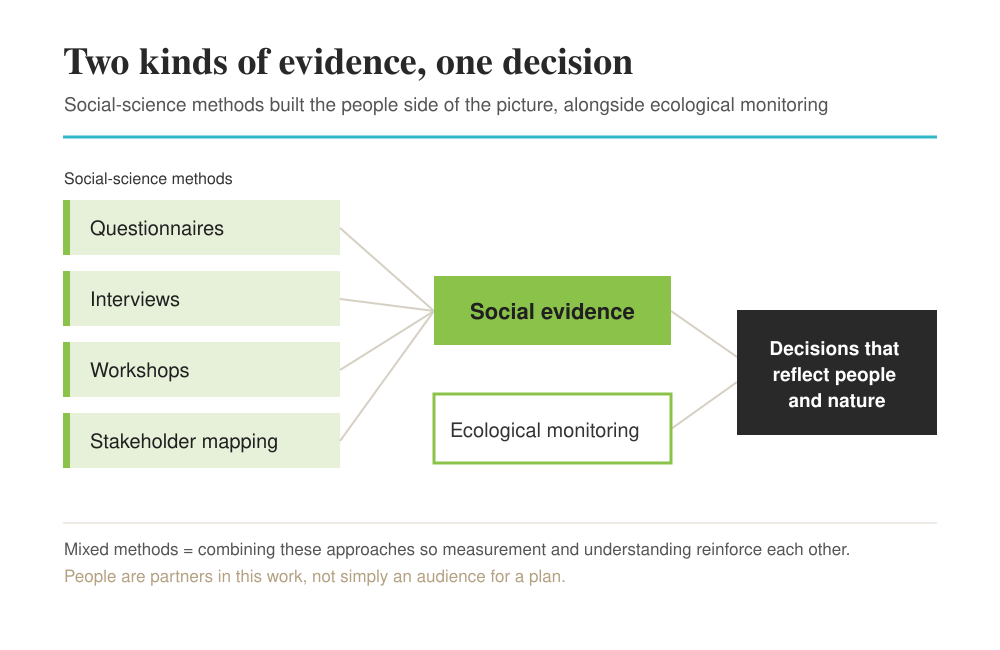
Methods from social science and the humantities-including questionnaires, interviews, participatory workshops, stakeholder mapping and mixed-method approaches-allow practitioners to gather robust evidence on how conservation affects different groups of people.


Increasingly, conservation organisations are integrating social indicators alongside ecological monitoring. Measures such as trust in management authorities, place attachment, perceived fairness, stakeholder participation and wellbeing are becoming important components of project evaluation.


This reflects a broader shift towards evidence-based conservation that recognises both ecological and social dimensions of success.


The future of conservation is interdisciplinary


In EcoTransform we believe that today’s environmental challenges-including biodiversity loss, climate change and landscape restoration-cannot be solved through ecological science alone.


Effective conservation requires collaboration across disciplines and sectors. Ecologists, social scientists, economists, planners, practitioners, communities and policy-makers all contribute different forms of knowledge that together support more effective decision-making.


Conservation social science provides the tools to understand how people perceive nature, how institutions shape environmental management, how communities respond to conservation interventions and how projects influence society.

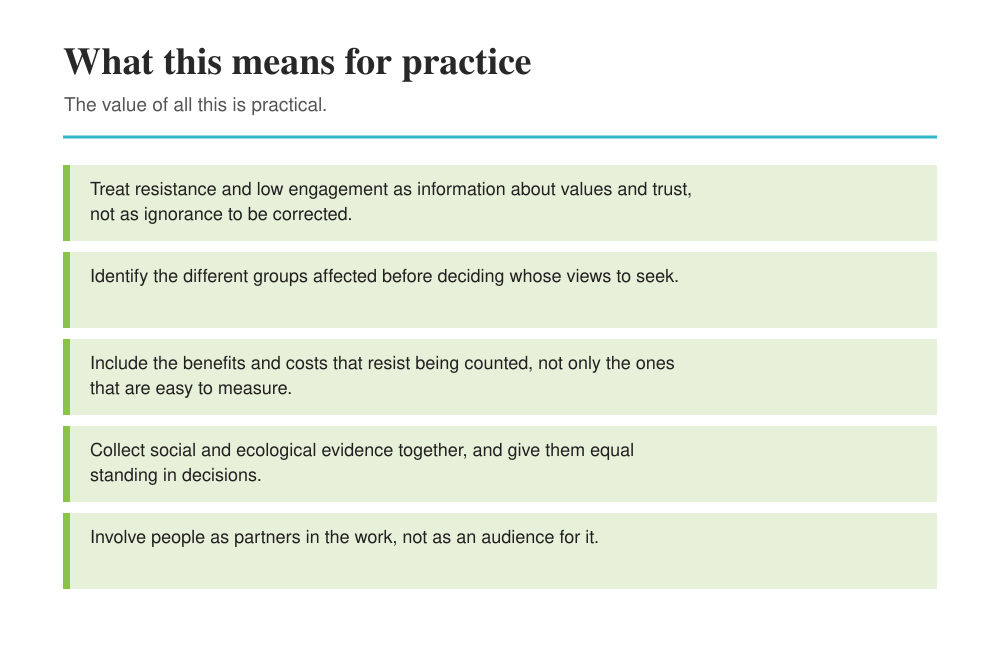
Rather than viewing people as obstacles to conservation, modern conservation increasingly recognises people as partners, beneficiaries and stewards of the natural environment.


This does not mean that biodiversity objectives become secondary. Instead, it reflects a growing understanding that ecological and social goals are often mutually reinforcing. Projects that are socially inclusive, locally supported and responsive to community needs are generally more resilient, more effective and more likely to achieve lasting conservation outcomes.


As governments, NGOs and practitioners invest in ambitious restoration and nature recovery programmes worldwide, integrating robust social evidence into conservation planning has never been more important. Conservation social science helps ensure that conservation not only protects biodiversity but also contributes to healthier communities, stronger governance and more sustainable relationships between people and nature.


In the years ahead, understanding these human dimensions will remain central to delivering conservation that is both ecologically successful and socially meaningful.