Social Science Tools and Methods for Conservation
Build practical social science skills for conservation
Understanding the relationships between people and nature is essential for effective conservation. The SOCIAT Training Programme provides conservation practitioners, researchers and organisations with the knowledge and practical skills to apply social science methods in conservation planning, management and evaluation.
Through a combination of theoretical insights and practical exercises, participants will learn about stakeholder engagement, social outcomes, questionnaire design, qualitative interviews, monitoring and evaluation, and Theory of Change. By the end of the programme, participants will be better equipped to collect and interpret social evidence and use it to inform conservation decisions and practice.
Originally developed and delivered by the University of Warwick as part of the SOCIAT programme (2024–2026), the training is now led by EcoTransform, under the direction of Professor Nikoleta Jones, together with a team of experienced environmental social scientists.
Topics covered
- Conservation Social Science: The Basics
What is conservation social science and why does it matter? - Stakeholder Engagement
Who are the people affected by or involved in conservation, and why should we engage them? - Social Outcomes of Conservation Projects
What are we trying to understand about how conservation affects people? - Questionnaires
How can we collect quantitative information about people’s knowledge, attitudes, behaviours and experiences? - Interviews
How can we gain deeper insights into people’s perspectives, experiences and values? - Monitoring, Evaluation and Theory of Change
How do we use social data to monitor and evaluate whether conservation projects are achieving their intended outcomes?
Online training course-Registration now open
The course includes
6 * 2 hours live training sessions by experts.
One-to-one mentoring sessions to discuss how conservation social science methods can help you in projects you are involved.
12+ hours of independent learning and practical exercises.
12 months access to SOCIAT pages including resources, publications, reports and tools.
Who is this training for?
The SOCIAT training programme is designed for anyone interested in integrating social science methods into conservation practice, including:
- Conservation practitioners and protected area managers
- NGO and civil society professionals
- Policymakers and public sector professionals
- Researchers and students
- Environmental consultants and sustainability professionals
No previous experience in social science is required.

Registration
Registration is now open for the January–March 2027 online SOCIAT Training Programme.
Applications will be reviewed to create a diverse cohort of participants from different sectors, regions and levels of experience, and to help tailor the training to participants’ needs.
Apply for the SOCIAT Training Programme
For questions about the programme or your suitability to participate, please contact contact@ecotransform.co.uk.
Key Dates
20 November 2026: Registration deadline
30 November 2026: Confirmation of places
December 2026: Initial individual meeting (30 minutes)
January–March 2027: Six live online training sessions
February–March 2027: Individual mentoring session with Professor Jones
Live Online Sessions
| Date | Time (UTC) |
|---|---|
| Friday 15 January 2027 | 13:00–15:00 |
| Friday 29 January 2027 | 13:00–15:00 |
| Friday 12 February 2027 | 13:00–15:00 |
| Friday 26 February 2027 | 13:00–15:00 |
| Friday 12 March 2027 | 13:00–15:00 |
| Thursday 25 March 2027 | 13:00–15:00 |
The programme also includes two individual sessions: an introductory meeting to discuss participants’ interests and needs, and a mentoring session with Professor Jones to explore questions related to their own work or conservation projects.
Fees
The standard course fee for the online SOCIAT Training Programme is £600 per participant.
You may choose to:
- Pay the full course fee of £600 in advance; or
- Pay in three instalments of £200 (December-February-March).
The programme combines expert-led teaching, practical exercises, peer learning opportunities, personalised mentoring, and access to a comprehensive library of resources to support participants in applying SOCIAT approaches within their own projects and organisations.
To ensure meaningful interaction, personalised feedback, and opportunities for discussion, places are limited.
Subsidised Places and special rates
A limited number of subsidised places are available for participants who may otherwise face financial barriers to participation.
Also, if you work for an organisation that is a member of EUROPARC Federation please get in touch as special reduced rates may be available.
Our Social Enterprise Commitment
EcoTransform is a social enterprise dedicated to strengthening connections between people and nature. We aim to keep the SOCIAT Training Programme accessible while ensuring high-quality delivery and fair compensation for trainers.
Any surplus generated through the programme is reinvested into activities that strengthen connections between people and nature, including community-based initiatives, capacity-building activities, and projects that promote the social benefits of conservation and nature restoration.
Other training opportunities
Free online module in collaboration with EUROPARC Federation
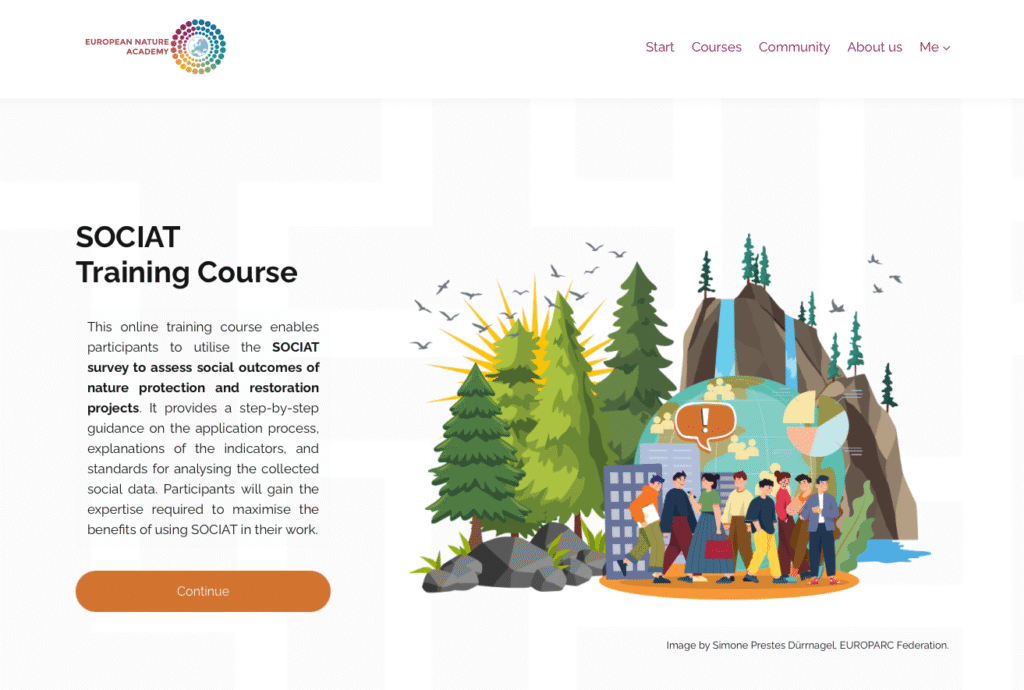
One way we support organisations is through a free online course, developed in collaboration with the EUROPARC Federation and hosted on the European Nature Academy platform. The course focuses specifically on the SOCIAT survey, providing step-by-step guidance on its application, an introduction to the indicators, and guidance on analysing the social data collected. It is designed to give participants the knowledge needed to apply the SOCIAT survey effectively in their own nature protection and restoration work. You can access SOCIAT course alongside other courses offered by the Academy here: https://www.europeannatureacademy.com/courses
Face to face training

We offer tailored face-to-face SOCIAT training for conservation organisations, protected area managers and other practitioners interested in integrating social science methods into their work. Our training combines practical exercises with hands-on learning in methods such as surveys, participatory mapping and in-depth interviews, helping participants better understand the social dimensions and outcomes of nature protection and restoration.
Building on two successful training courses delivered in 2025, we can adapt the content and format to meet the specific needs of your organisation.
Interested in organising a training course for your team? Get in touch to discuss your requirements.
Find out more about previous SOCIAT training delivered at the University of Warwick.
Testimonials
Training participant, working for national NGO in South East Asia, June 24-25 Online cohort
One of the best quality learning and development experiences I have had in the sector
Training participant, working for the civil sector, UK, June 2025 (face to face)
What I’ve learned really connects with what I am doing as conservationist working on human-elelhant projects… what I’ve learned in the social impact assessment course I am going to apply it back home as I am working with people managing conflict.
Training participant, Working for international wildlife NGO in Africa, Summer 2025 cohort (face to face)
I really enjoyed being part of the course and have the opportunity to learn from the colleagues and participants as well. I think we are facing similar challenges and the classes were also a space to share them.
Training participant, working for international wildlife NGO in South America, 24-25 online cohort
Training participant, Working for UK conservation organisation, June 2025 (face to face)